Web GIS portfolio example
Interactive geographic CV map for a research career.
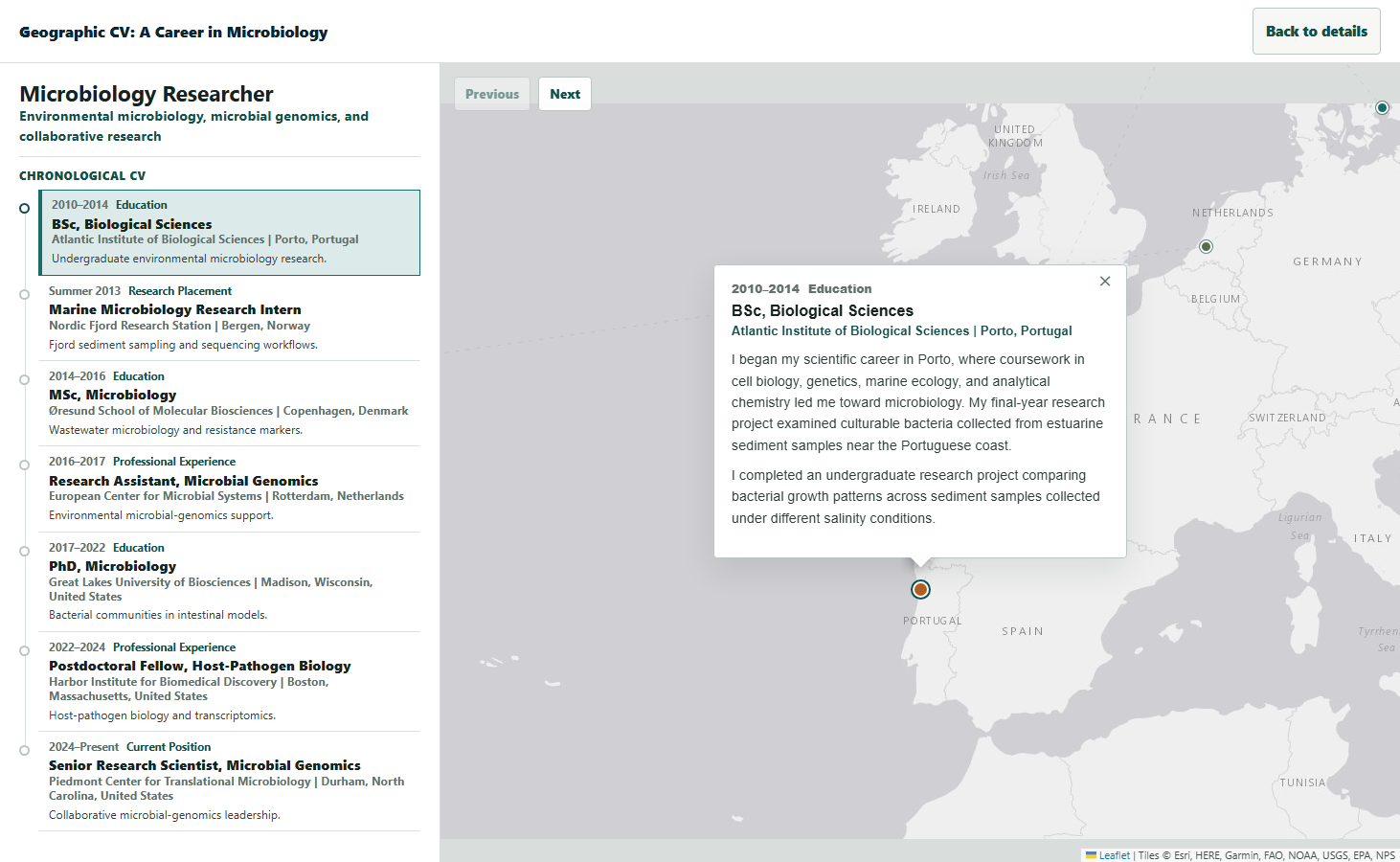
This portfolio example shows how a traditional resume can become a structured web GIS experience: a chronological career timeline, mapped research locations, focused markers, and accessible fallback content that remains useful without the interactive map.
Project context
This page demonstrates a resume format where geography carries real meaning. Each career stage is available in a chronological timeline, and the map gives readers a second way to understand movement across countries, institutions, field settings, and research roles.
The same approach can support professional biographies, project histories, field programs, grant narratives, public outreach pages, and other stories where location and time help explain the work.
Challenge
A conventional CV can be dense and linear. The goal was to preserve the full career record while adding spatial context, without forcing the reader to rely on the map alone or hiding key information behind JavaScript interaction.
Approach
The standalone map uses Leaflet, a restrained light-gray basemap, custom markers, brief timeline summaries, and larger readable popups. The timeline and popup copy are intentionally different: the timeline stays concise for scanning, while popups provide more narrative detail when a reader wants context.
The portfolio wrapper keeps the search-facing content separate from the standalone interactive page. Google and other crawlers can evaluate the case-study explanation here, while visitors can open the full interactive CV when they want to explore the mapped experience.
Deliverables
- Search-facing portfolio case-study page
- Standalone HTML and JavaScript interactive CV
- Leaflet map with custom markers and focused popups
- Chronological career timeline with non-map fallback content
- Screenshot thumbnail for portfolio listings and social previews
Results
The finished item gives a research career a clearer spatial narrative and provides a reusable pattern for professional journey maps, institutional timelines, and project portfolios that need both chronology and geographic context.